We will do and we will understand
Art lessons from Sinai
I am designing a new website at the moment. At least 18 months ago, I took my old one down and set up a page that declared Coming Soon! I intended that in a few weeks it would be viewable, all sparkling and enticing. In fact I only started work on it last week. What happened?
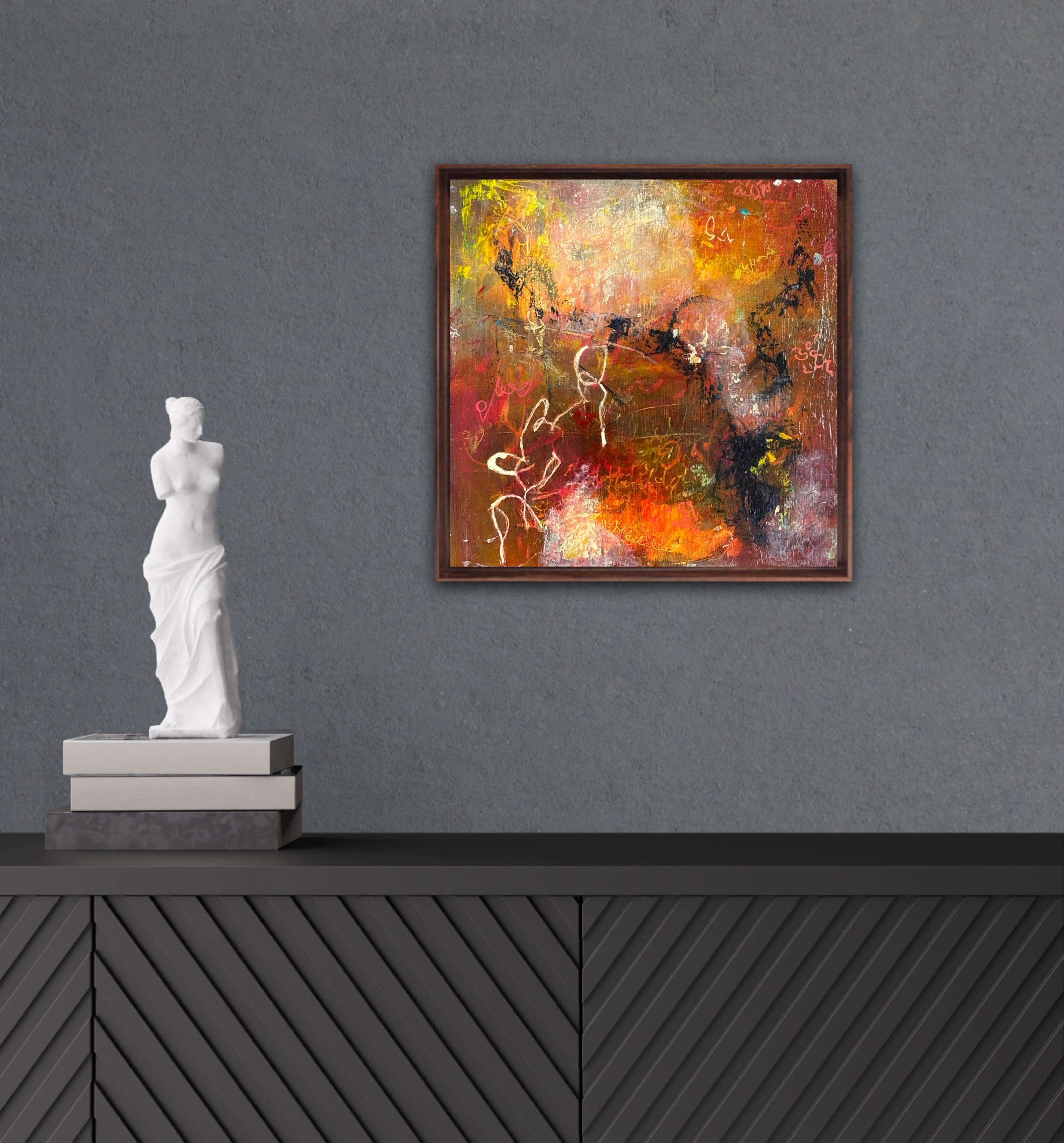
Standing At Sinai 3 - Art by Helen Conway
The surface answer is of course: nothing happened. But under the surface a lot was taking place.
I enjoy the technological process of web design. I’m no expert, but I can find my way round the back end of Wordpress. What I couldn’t find was the creative identity I wanted to portray to the world. Who was I? And did the word even need a website about me?
The whole word has, I think, since 2020 navigated a great deal of change. The pandemic revolutionised the workspace. The descent of political ethics in the US has reverberated around the world. The Hammas attacks on Israel and the appalling nature of the following response in Gaza has rocked those who care. Out of that western-focused lens there have been other global political and environmental events that have fundamentally altered lives. Yet, even as we struggle to stand stable in a volatile world, we all also face internal challenges.
In that same time scale, I’ve grappled with my own illness, early retirement, the loss of my mother in law, menopause, the major accident and then supposed terminal illness of my husband (in fact, he recovered), the illnesses of my parents and major challenges in the community which (when functioning well) acts a source of support to me and a place for me to give back. The journey of entering this second half of life with all its new opportunities was a trip that didn’t have a smooth landing!
It’s fair to say that a period like that shakes you up, chips bits off you and requires a certain reflective process of reconstruction. And, in my case, at least, some courage.
Looking back, what’s been happening under the surface is a process of reconfiguring how all the parts of me relate to each other. Whether you approach it though the poetic words of Walt Whitman ( I am multitudes) or the theory of Internal Family Systems therapy/coaching, we all have a multiplicity of roles and psychological characters that form our whole identity. This period has, for me, been one of sorting out how to integrate what had become a collection of, if not conflicting, at least disconnected ‘parts’ of me. I am artist, lawyer, coach, daughter, wife, friend, choir member, learner, teacher, assessor, reader, writer… and so it goes. I am knowledgeable and still ignorant, confident and scared, talented and unskilled. I feel I have a lot to say and I feel have nothing to say and nowhere to say it!
I suspect I am not alone in this because, no matter how it feels sometimes, we are never alone in our human experiences. We all go through times when our identity shifts as we leave jobs, lose a relationship become empty nesters or suffer a period of disability. Navigating it draws in many factors – the topic is fact too complex to cover in one Substack – but I will write here about one aspect that relates to the creative process of designing my website.
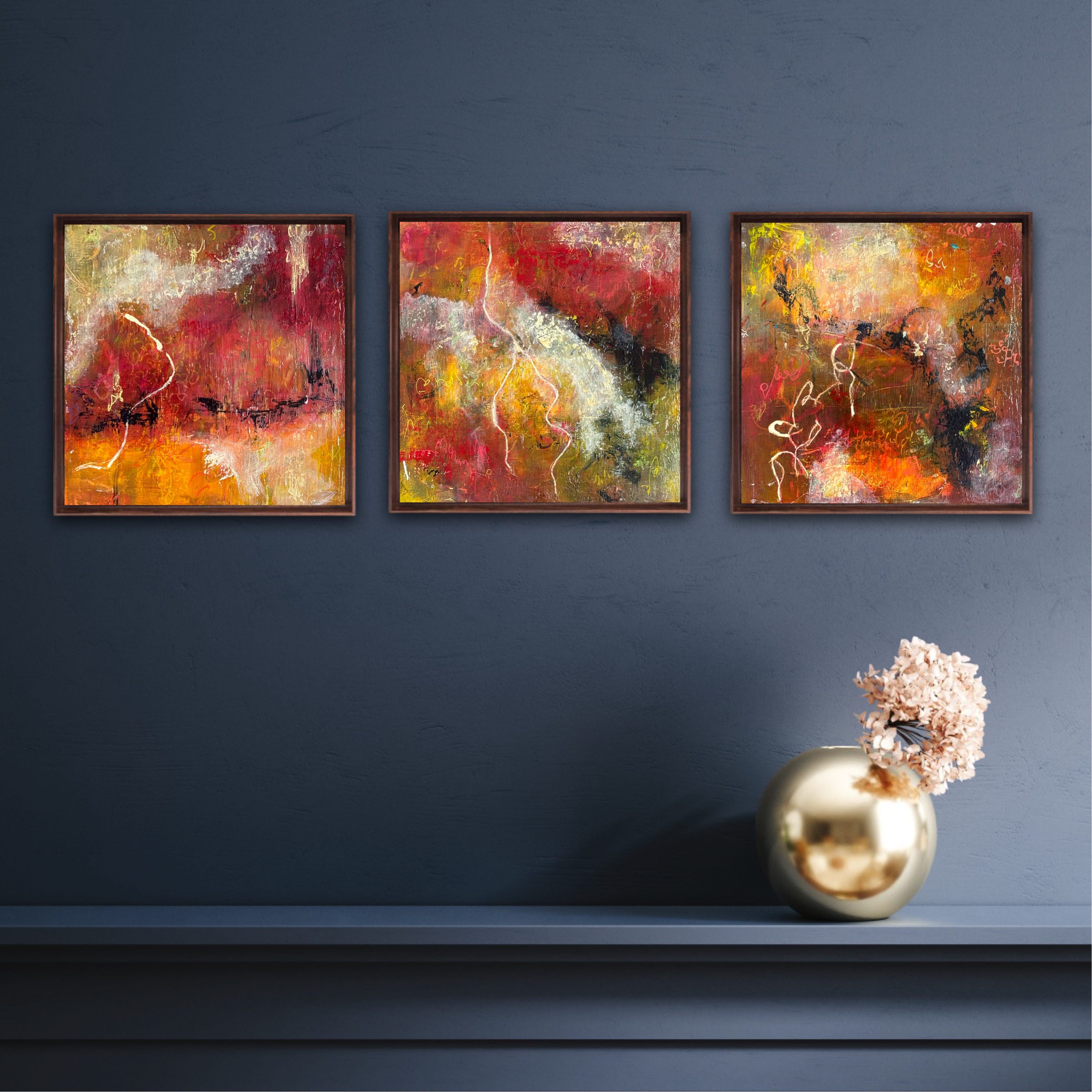
Standing At Sinai 2, 1 ,3 - Art by Helen Conway
As I thought, considered, journalled, reflected (and, OK, also procrastinated), it became clear that there was one part of me that acted as the conductor holding the orchestra of my other parts together. And that was the part that loved the ancient wisdom of Judaism. It was the part that had found a culture and a theology that allowed grappling and arguing, that provided questions relevant to all areas of my life, and which supported a multiplicity of answers all of which could be different and right at the same time. It was the part that was showing up overtly and subtly in the artwork I was wanting to show on the website. It wasn’t everything in my life by any means, but it is the part that touches all the others. And it’s the part that in the post-October 7th era is the very hardest one to lead with in public.
That’s my shtick (to appropriately appropriate a Yiddish word.). Yours will be different. The part of you that is asking to step forward in your life right now might be an easy one to show off. Mostly, if you are about to become a grandparent or retire to travel in a Winnebego for a year it feels acceptable to make that the public focus of your social media or your blog. But not always. What if your best friends have children with fertility issues or you live in a fiercely environmentally activist community? And often, other key parts of us feel really hard to reveal.
That might be because we have a cruel society – being an immigrant, a trans person or, honestly, just a decent human being with ethics, can today be extremely hard. Or it can be because we have a loud part that is cruel to our other parts. We can make the simple showing up as a seascape artist extremely challenging by our own self talk. ‘I’m not good enough, who wants more seascapes? My work has nothing to say. I should get a proper job. Or in my case, thoughts ranging from This will bore most people, right through to This will attract nasty internet trolls.
We are constantly told by People On The Internet, that we must find a niche, be authentic, be unique. That our value lies in showing up as who we truly are. Often that’s in a commercial context that commodifies our vulnerability. What we don’t hear so much about is that as creators, as humans, we change. That we go through periods where our authentic niche is Hot Mess or Lost In the Woods. That sometimes we need to not show up in public. Too few people say that, even when we know our authentic niche, we are going to feel like a little fluffy baby chick in an old human body, bits of shell still stuck to its feathers, peering over the branch, afraid to take our first jump. Because even if this is our eighth personal website iteration, it feels like entering the world anew because we are introducing the newly emerged version of ourselves.
But how do we even get to that recognition of our new selves?
In my case at least it crept up, growing daily. When I paid attention, I got a glimpse of how I wanted to show up in the world, but then that glimmer got lost behind all the other options, the worldly noise, the fears, the unfamiliarity, the feeling that it needed sheer chutzpah to pull off. But I kept looking at it, beckoning it, giving it the time of day. welcoming it but letting it be shy. Taking small steps to give it opportunity to come into the daylight. Eventually I had a clear sense of what the organising part was and what I felt called to express, but I had no idea – have no idea – how it will work, if it will work, what the consequences will be, what mistakes I will make and learn from, what unexpected opportunities will arise.
That stage can be exactly when we turn back because it feels so unlikely that something we don’t understand can be the right way forward. I imagine every egret looks down from that branch at the ground far below and chirrups to its mother: yeah I feel like I am growing into a soaring bird but, you want me to do WHAT? That’s doesn’t sound like a good idea. Maybe I’m meant to be a penguin. Let’s look at that option instead.
For me, the moment of taking the final courage to type into the new draft home page the big bold header words Jewish Abstract Art, was a wonderfully circular self-proving event. I had made the pieces which illustrate this piece. I didn’t like them because I didn’t really understand why I had made them. They came from play. They were saying nothing to me, and it matters to me that my art has a meaning. I left them in the studio and went for a study session with my Rabbi, Kath Vardi.
We looked at the Bible text of the famous Charton Heston-portrayed biblical story, in which, with much smoke and ground shaking, thunder and lightning, God gives Moses the Ten Commandments. This is a deeply creative time when the Israelites start to found a new way of living, a whole new society of thinking about who they are becoming. We talk about ‘Standing at Sinai” as referring not only to this story which, if it happened at all, happened 3000 years or so again, but to the experience now of receiving ‘continued revelation’. Sometimes that can be about big important societal changes. (Judith Plaskow’s seminal book about feminism is entitled Standing Again at Sinai.) Equally it can be that still small voice of new understanding and discovery, of the world, of our inner selves.
Rabbi Kath pointed out that English translations often say that the people ‘witnessed’ or ‘perceived’ the thunder. But the Hebrew actually says the people ‘saw’ the thunder. How can that be? There are medieval commentaries that suggests that this was such a momentous occasion that the Israelites experiences a kind of sysnethesia. But how does that sit today when we have a different view of the Divine, if we believe at all? (Most non-religious creators do I think experience the idea of a Divine if interpreted in the sense of a ‘muse’ or a Source of Inspiration outside ourselves.) As with all Torah study, I left with questions to ponder as I entered my studio and looked again at pieces that suddenly, so obviously had visuals of both dark thunder and lightning, and clearly were about the concept of Standing at Sinai.
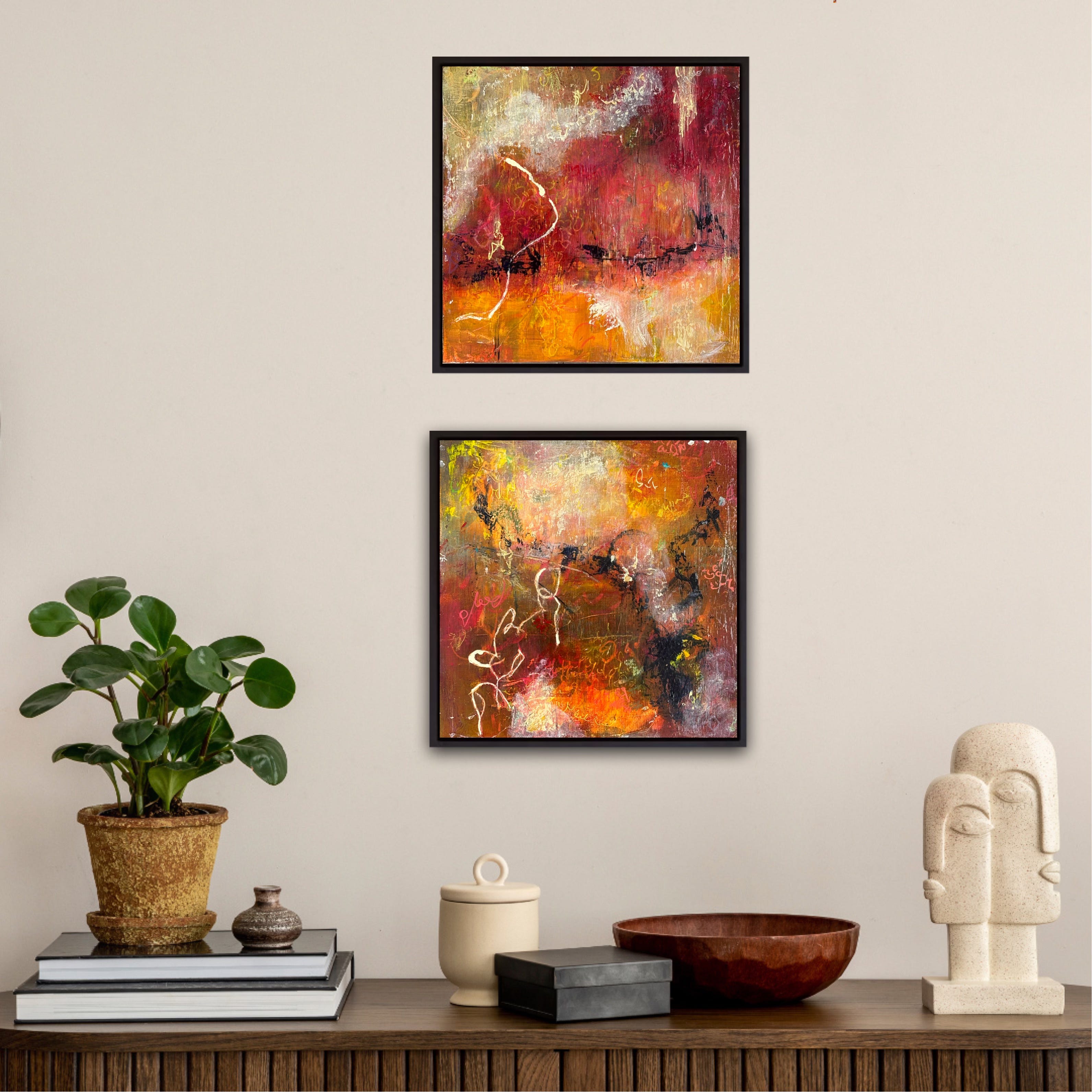
Standing At Sinai 2 and 3 - Art by Helen Conway
In that story, the people twice listen and say that they will do what they are told to do. Then having been given both inspiration from God and technical information via Moses (akin to an artist being helped translate a bolt from the blue idea into reality via a mentor or teacher) we come to a famous quote. The people are given a reading of the ‘manual’ of this new society, containing pretty high-level ideas, which will need to be worked out, and they say na’aseh v’nishmah meaning: we will do and we will understand.
Sometimes we have to make first, then figure out what it’s all about. We have to do the things we are drawn to do then watch to see what kind of person we are becoming as a result.
So I set up the new website with a collection gallery labelled Standing at Sinai and started to write a blog post about that art. And then I understood how that related to my personal development and then I understood what this Substack (for which I previously had no ideas) should be about. And now I am little bit braver and a little bit clearer about the next steps. Doing what I was drawn to do today was the way I understood what I was meant to do next.
The question remains: does the world need a website about me? On the one hand No, I am nothing special. We are all fundamentally alike. (But I think we all need material on the Internet that’s says: I struggled with this and I tried anyway and this is what I learned and how, in my idiosyncratic way, I learned it. Take it if it helps you.) On the other hand yes, we are also special, you included. We all have something to show that is worthy of space. What I make and what you make is never going to exist again and that the wonder of that should be celebrated. (If you need a practical way to remembering those contradictory but equally true concepts try this idea.)
So I’m going to keeping working on the website, designing not what feels safe but what feels right. Not least because by doing so, I’ll understand more about why I felt I needed to do it. And hopefully I’ll help others understand their own way too. And so the circle turns.
L’Shalom,
Helen
PS You’ll be the first to know when the website is ready!
Thank you for these helpful thoughts
Oh Helen! What an amazing experience you have shared. Thank you. It's great to see you expressing yourself through paint again as well. Standing At Sinai is a vibrant storm unleashed to break the drought! Sending positives as you navigate the various parts of your life & complete your website. I am so glad your art & writing is out in the world.